By Shana Smith, Curator, Port Gamble Historic Museum
Originally published in the January, February, May, and June 2000 issues of the Port Ludlow Voice
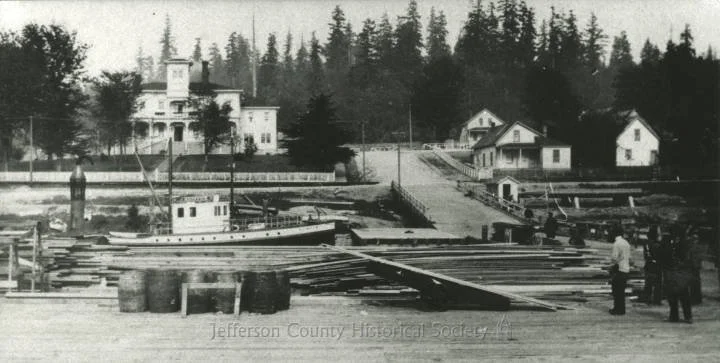
Have you ever wondered what's behind a name, or specifically a street name? There are many subdivisions and villages in Port Ludlow, and while some names are straightforward, others hold deeper stories. When Pope & Talbot, Inc. began developing Port Ludlow in 1968, nearly every chosen name had a specific meaning, pulling from the area's rich maritime, lumber, and familial history.
Adventurer Lane: The P&T Adventurer was a C-3 vessel and a Victory ship. The Adventurer was part of Pope & Talbot’s Pacific Argentine Brazil Line.
Ames Lane: Edwin G. Ames, from East Machias, was related maternally to C. F. A. Talbot. Ames had been the protégé of his grandfather; he learned the business and the lore of Pope & Talbot thoroughly. Ames advanced rapidly within the company and was with the company for 50 years. He built his Seattle home in Washington Park, a Pope & Talbot development in Seattle. Ames eventually bequeathed this house to the University of Washington for use as the official residence of its president.
Baldwin Lane: A. R. Baldwin was a member of the Board of Directors of the Puget Mill Company in the early 1930s. In 1935 he became legal aid for the company. In 1940, Baldwin directed the consolidation of Puget Mill Company and Rainier Investment Company, and was instrumental in assisting with the formation of Pope & Talbot, Inc.
Camano Lane: Captain George Vancouver sailed in northern Puget Sound in 1792 charting shorelines shaped by the Vashon Glacier approximately 12,000 years earlier. Utsalady on Camano Island was the site of a Pope & Talbot lumber mill in 1877. Pope & Talbot shut the mill down in 1890, never to reopen again. The Camano was also the name of a topsail schooner that was built in 1902 for the Puget Mill Company.
Condon Lane: Richard Condon worked for the Puget Mill Company from 1884 and held various positions in the company. He was in charge of the mills after Ames and the main Puget Mill office moved to Seattle in 1907. Later Mr. Condon was the sales manager in Seattle with instructions to prepare to enter the railroad trade and push water-borne shipments to the Atlantic seaboard.
Cressey Lane: Lewis Cressey operated Camp Gamble for the Puget Mill Company which produced almost 86,000,000 feet of logs during its three years of operation. In 1925 the Puget Mill Company had another job for Cressey. The development of Alderwood Manor in north Seattle was underway and Cressey built all the roads in the tract and cleared one acre of each plot. Lewis Cressey’s biggest contribution is that he knew the location of every piece of Puget Mill property in the state, and even today surveyors find corner markers set by him in the early 1920s.
Drew Lane: Michael S. Drew arrived in 1858 and worked for the Puget Mill Company until 1899 when he moved to Seattle and entered the real estate business. During his years, he held a variety of jobs including timber agent and “overseer in the mill.” As the timber agent he purchased so much land on its behalf, that the Puget Mill Company became the largest owner of timberland in Washington. Fred Drew was a log agent for the Puget Mill Company and then later the land agent.
Evans Lane: Former Senator and Governor Daniel Jackson Evans is a relative of Daniel Bachelder Jackson.
Explorer Lane: The P&T Explorer was a C-3 vessel that was acquired from the U.S. Navy in 1947. The U.S. Navy name was USS Hampton. The P&T Explorer was sold in 1963 to the American Foreign Steamship Corporation and re-named the American Falcon.
Forester Lane: The P&T Forester was one of the first two C-3 vessels bought from the Maritime Commission in June of 1947. The service of the vessel was between Pacific Coast ports of the United States and South America. The Forester was able to accommodate 12 passengers and was 12,805 tons with 50,000 cubic feet refrigerated cargo space. The Forester was sold in 1963 to the American Foreign Steamship Corporation and renamed the American Robin.
Foster Lane: Charles Foster was one of the original four partners that formed the Puget Mill Company. He also was first cousin to the wife of Captain Talbot, one of the other partners. After Keller's death, Pope & Talbot bought out Charles Foster's interest in the Puget Mill Co.
Gamble Lane: The word Gamble has had many uses over the years for Pope & Talbot, from the town of Port Gamble to a schooner and a logging camp. Lt. Robert Gamble was wounded in a sea battle between the U.S. frigate President and the British Belvidere during the War of 1812.
Goliah Lane: From the time the Puget Mill Company’s Goliah appeared on Puget Sound in 1871 to about 1876 or 1877, she is reported to have towed practically every sailing vessel destined for the American side and about half of those bound for the Straits of Nanaimo. The second Goliah was purchased in 1909 and continued working in Puget Sound for Pope & Talbot.
Grove Court: I could not find any information on Grove, but one of the greatest Puget Sound tugboat masters was Captain William Gove. In forty-eight years of continuous service, Captain Gove never had an accident of a serious nature involving his own tug or the vessel in his charge. Maybe Grove was supposed to be Gove?
Harms Lane: During the years of the Charles R. McCormick Lumber Company, Alfred G. Harms was elected to the board to represent the Puget Mill interests. Mr. Harms was on the board of directors for the Puget Mill Company and was elected first vice-president of both the lumber and steamship companies.
Helm Lane: C. E. Helms worked for the Charles R. McCormick Lumber Company and was in charge of the rehabilitation of the mill properties. Later when Pope & Talbot reacquired the properties, C. E. Helms was elected vice-president and general manager of the lumber and steamship companies.
Jackson Lane: Daniel Bachelder Jackson arrived in Port Ludlow in 1859 and worked there until 1871. He then moved to Port Gamble to command the Puget Mill's fleet of steamboats. In 1882 he organized the Washington Steamboat & Transportation Company with a contract for carrying mail and daily passenger service. Mr. Jackson was the third postmaster of Port Gamble, a position he held until 1886.
Keefe Lane: J. Keefe drew the 1885 townsite and mill map of Port Gamble.
Keller Lane: Captain Josiah P. Keller was part owner and manager of the Puget Mill Company, owning a one-sixth interest. His wife was the cousin of Captain Talbot. J. P. Keller commanded the Brig Oriental, as did Captain Talbot. Captain Keller died in 1862 in Victoria, BC and it was soon after his death that Pope & Talbot bought out the interests of the other partners.
Libby Court: The first master of the Goliah was Captain S. D. Libby, "Old Man Libby," as he was affectionately known from Flattery to Olympia.
Machias Loop: The founders of Pope & Talbot and many of the original workers at their mills and ships were from East Machias, Maine. Machias and East Machias are located in the eastern portion of the state of Maine, on the coast, near the Bay of Fundy and the Grand Manan Channel.
McCurdy Lane: Horace V. McCurdy was a shipbuilder in Seattle and instrumental in the establishment of the Museum of History and Industry (MOHAI).
Montgomery Court/Lane: E. Geoffrey Montgomery served as a member of the Board of Directors from 1950 to 1968. A. E. Montgomery and George G. Montgomery served as Senior Vice-President and member of the Board of Directors in the late 1960s and early 1970s.
Navigator Lane: The P& T Navigator was also a C-3 vessel that was acquired from the U.S. Navy in 1947. The Navy name was USS Guilford. In 1963 the Navigator was sold to the American Foreign Steamship Corporation and renamed the American Oriole.
Olympic Lane: Robert Gray, an American, and Captain George Vancouver, an Englishman, did the most enduring surveys of this region. Olympic is named for the mountain range and Mount Olympus.
Pathfinder Lane: The P&T Pathfinder was a C-3 vessel. The Pathfinder was part of Pope & Talbot’s Pacific Argentine Brazil Line.
Phinney Lane: In 1858 Arthur Phinney with his partners Zachariah Amos and William Hooke leased the Sayward-Thorndyke mill. Mr. Phinney, like Captain Talbot, was banking on a bright future for the mill as he operated it. By 1869 he owned the entire Ludlow mill operation. Arthur Phinney was rebuilding his mill to compete with other mills when he died in 1877. The mill was sold at auction in November 1878 to the Puget Mill Company.
Pioneer Drive: Pope & Talbot owned two tugboats with the name Pioneer. The Pioneer I was built in 1878 and was a steam screw vessel with a length of 107 feet. She was sold to Foss Launch & Tug Co. in 1949. The Prothero Boat Company built the Pioneer II.
Pope Way: Andrew Jackson Pope was one of the original partners in the Puget Mill Company and later Pope & Talbot, Inc. Ever since 1850, Pope had been known as "A. J. Pope, lumber merchant." Besides his partnership, A. J. Pope also acted on behalf of the Pope interests, as represented by the firms of Wm. Pope & Sons of Boston and S. W. Pope & Co. of East Machias. A.J. Pope's wife was Capt. Talbot's sister. He died in 1878.
Puget Loop: British Navy Captain George Vancouver began to survey the surrounding area and dispatched Lt. Peter Puget to conduct a detailed survey of the waters to the south. Lt. Puget shoved off in a launch on May 20, 1792 on a six-day tour of the southern sound. Captain Vancouver named it Puget after his Lieutenant.
Rainier Lane/Court: The name Rainier was selected by Captain George Vancouver after his friend, British Rear Admiral Peter Rainier, who never saw the mountain or set foot in the United States.
Resolute Lane: Two prominent millmen joined forces to buy the first towboat to appear on Puget Sound, the 89-foot Resolute. In 1857, W. C. Talbot of the Puget Mill Company and G. A. Meigs of the Port Madison sawmill bought the Resolute for towing in connection with their mill business. The Resolute towed thousands of logs not only for her owners but also for practically every sawmill on Puget Sound. She exploded in 1868 in Olympia.
Sayward Lane: W. P. Sayward rented the sloping site on Ludlow Bay from homesteader J. K. Thorndyke and built one of the first sawmills of the Northwest.
Seafarer Lane: The P & T Seafarer was one of the first two C-3 vessels bought from the Maritime Commission in March of 1947. The U.S. Navy name was USS Mendocino. The service of the vessel was between Pacific Coast ports of the United States and South America. The Seafarer was able to accommodate 12 passengers and was 12,805 tons with 50,000 cubic feet refrigerated cargo space. The Seafarer was sold in 1963 to the American Foreign Steamship Corporation and renamed the American Hawk.
Swansonville Road: In the 1890’s Grandpa Swanson left Norway and arrived in Port Gamble where he supervised the loading of the ships. Mr. Swanson, looking for a place to raise his family, found land in Port Ludlow at the top of the hill west of Port Ludlow Bay. He then worked at the mill in Port Ludlow and built his home at the top of the hill, in what is now known as Swansonville. A number of the Swansons are still living in the area and much of the original farm is still held by family members.
Talbot Way: Frederic and William C. Talbot were brothers who were part of the original Talbots in Pope & Talbot. There were many Talbots through the years who advanced within the company. Frederic Talbot decided to return to Maine and his brother William became the principal Talbot of the new enterprise. Captain Talbot in 1853 explored and found the site of their first mill, Port Gamble. He died in 1881.
Trader Lane: The P& T Trader was a C-3 vessel that was acquired from the U.S. Navy in 1947. The Navy name was USS Sitka. The Trader was part of Pope & Talbot’s Pacific Argentine Brazil Line.
Tyee Lane: Owned by the Puget Mill Company, the Tyee was the most powerful tug on Puget Sound, measuring in at 140 feet in length. It was also one of the few coal burning tugs. The father of Harry Collier, former president of Standard Oil of California, was the first engineer aboard the Tyee.
Walker Way: Cyrus Walker accompanied Captain Talbot on his 1853 trip to select the millsite and remained as an employee. After Captain Keller died Pope & Talbot sold Walker a one-tenth interest in the total assets of the Puget Mill Company and made him Northwest manager. Walker remained active in the Puget Mill Company for 54 years.
Wheeler Lane: Charles L. Wheeler was vice-president and general manager of the McCormick Steamship Company. In 1935, Wheeler was made executive vice-president of both the lumber and steamship companies of Charles R. McCormick Lumber Company. In 1940, Wheeler became executive vice-president of Pope & Talbot, Inc.