

The Swansons
In 1888, Hans Ferdinand Svendsen (Swanson), age 34, worked as a Norwegian sailor leaving his homeland of Norway. It is said that his sailing vessel reached either Everett or Port Blakely, WA when he stepped ashore. Hans worked his way out to the Olympic Peninsula taking up work for the Port Ludlow’s Puget Mill Company and later for WR Grace and Co.
Since he knew ships, instead of just working inside the mills, Hans worked more often as a longshoreman, loading the ships with the mills’ lumber. This proved to be a godsend as Pope and Talbot closed the Puget Mill in Port Ludlow from 1890 until 1897 during an extended recession. During that time, Hans was able to continue to work loading ships in Port Gamble WA while the Port Ludlow mill was closed. He would stay in Port Gamble during the week and row his boat back and forth (a distance of 6-7 nautical miles) to his home in Port Ludlow on Saturday evening and back on Monday morning. During his career, he became the stevedoring foreman in both Port Ludlow and Port Gamble, also working for Rothschild’s and Grayson’s company.
Hans was born on May 8, 1854 in Vestby, Norway to Svend Kjeldsen (a farmer) and Martha Simonsdatter (a widow who had eight children from her previous marriage). As a young boy, there is unverified information indicating that he was rather an unruly child and at age nine was taken as a “cabin boy” on a ship where his 20some-year-old half-brother was also employed. (The Norwegian census in 1865 does not list Hans living with his mother and sister). Hans worked his way up as a sailor until he received his Master’s papers but there is no record that he ever was captain of a ship. He spent time at his home port in Norway between his many voyages.
On December 17, 1882, Hans married Helene Johansdatter of Tune (Vister), Norway (near present day Sarpsborg). Helene was born in Vister on January 16, 1860 to Johan Martin Svendsen and Inger Marie Hansdatter. Hans wasn’t at sea the entire time during those first years of marriage and they had 3 children within the first five years. We really don’t know why Hans stepped off his ship and stayed in the United States in 1888 but there have been guesses that the recession mentioned above, started much earlier in Norway, and the United States looked like a better way to support his young family.
Shortly after arriving in Port Ludlow, Hans sent for his wife Helene (Johnansdatter) Svendsen and their three children Inga, Sigurd, and Magnil. It is documented they sailed from Christiania (as Oslo was called during much of the 19th century) on the ship Alonzo on 2 May 1890, landing in Boston MA then crossing the entire United States in a railroad boxcar. In the following years, relatives of Helene followed her to the Swansonville area. Both the pioneering families of the Johnson’s and Hansen’s are relatives of hers.
The Swansons lived for a short time on the bay in Port Ludlow until they bought 23 acres of land on the hill eventually to be known as Swansonville. They cleared the land to build a two-bedroom cabin by hauling up lumber from the Port Ludlow mill in wheelbarrows. They had 10 dairy cows, chickens and turkeys, plus a large garden. In 1893, a new family house was built near their original cabin as the family grew to have 11 children. The farm continued to grow along with the family and over time added 80 acres. On October 8, 1894, Hans became a citizen of the United States. Another addition to their house was made in 1909 and it has been the same size ever since.
In 1904 or 1905, Hans and Helene donated a bit of land and supplies to build a non-denominational community church in Swansonville. Hans was a deeply religious man and attended the little white church in Swansonville until his death. He loved to sing and quote “Sams” (Psalms). His fundamental beliefs were very firm and he was not averse to stating them forcefully if any one might interpret the Scriptures differently.
Of the eight surviving children, Inga moved to Nordland; Sigurd, Harry and Arthur remained in Swansonville; Jennie married and moved to Chimacum; Magnil married and moved to Seattle; James settled in Bremerton; David in Tacoma. Enoch (June 12, 1899 - September 5, 1903), Esther May (May 17, 1901 – July 25, 1904) and Theodore (December 15, 1903 – January 20, 1908) did not survive childhood.
Life in Swansonville in the early homesteading days was far from romantic. Resources were few and all work to clear, build and work the land, was done by hand. When not at work, music was a favorite pastime for the Swanson’s as all the children had different instruments they played. Both Inga and Magnil played the piano, violin, and mandolin and taught both Harry and Arthur before age 10, how to play the piano, as well. Jennie and James also played the violin. David and Arthur played the clarinet. Sigurd could play both the mandolin and harmonica. Harry could play the trombone, guitar, banjo, mandolin and harmonica. Most were part of the church choir and it’s been stated that “The Swanson’s were wonderful singers.”
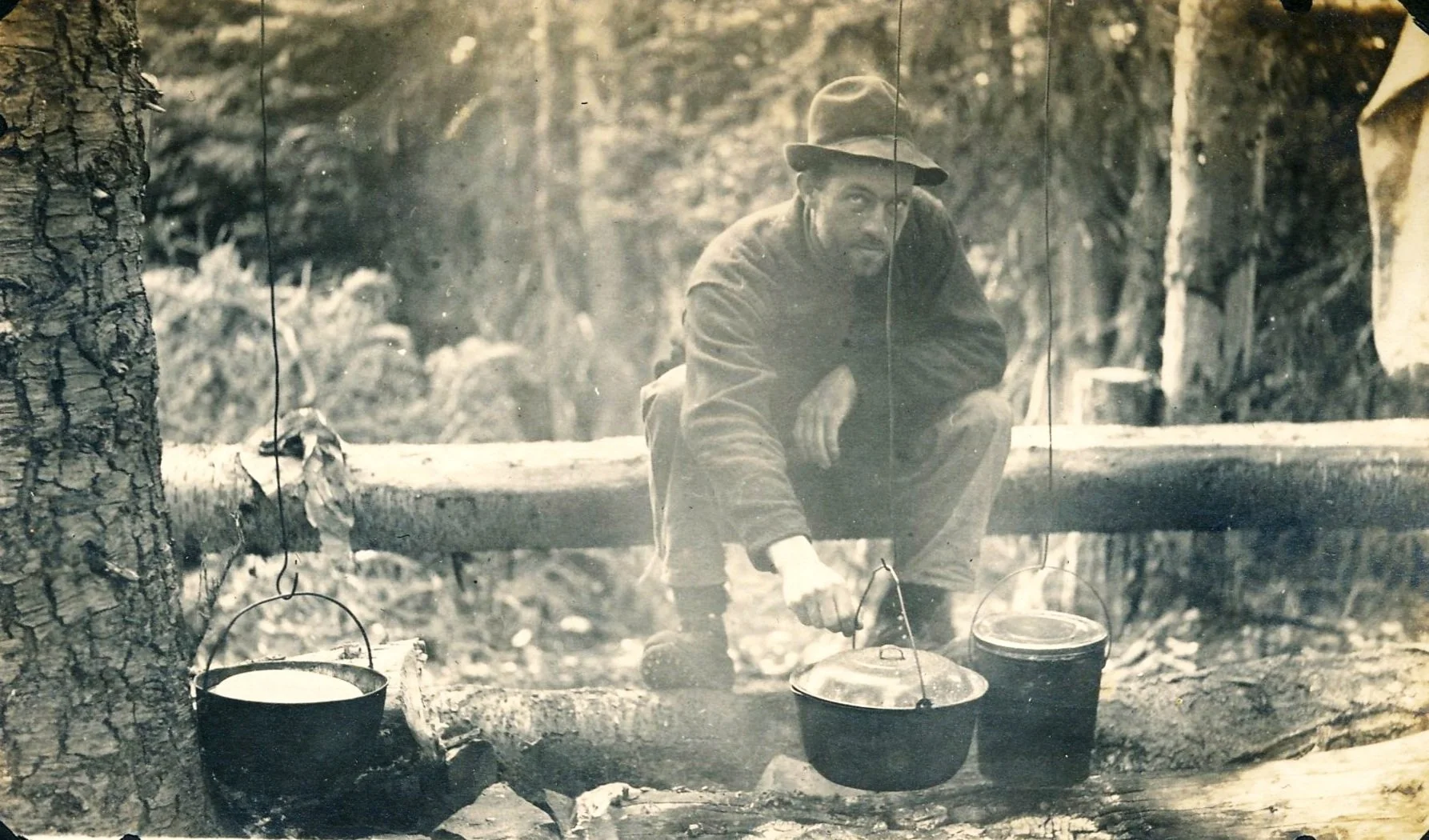
Hunting was a family week-long event, a yearly trip to Mount Townsend that became an annual event to bring in a substantial supply of meat. The newly married Signe Sellin Swanson, who married Arthur in 1921, spent her honeymoon in a tent camping on one such excursion.
Hans had to give up his livelihood as a stevedore when he was in his 60s, after appendicitis and many years of loading ship took its toll on his body. He kept at dairy farming in Swansonville, continuing to provide bottled milk to the community of Port Ludlow until “retiring” in 1926. In about 1930, no longer needing the larger house, he relinquished it to their son, Harry, and built a new home across from the homestead. Helene died on October 2, 1933 at the age of 73. In 1939, Hans moved into a smaller house on Olympus Beach near Mats Mats Bay. He died in 1946 at the age of 91.
Family traditions and gatherings were a way of life for most families but the Swanson’s have continued their celebration of gathering in the area of Mats Mats Bay for their Fourth of July Family Reunion. It has been ongoing during the last 100 years and has expanded over time to over 100 participants. Three different branches of the family have had property on Olympus beach and the reunion is staged there each Independence Day.
Eight Children of Hans and Helene Survived Childhood
Expand each section below to learn more about each:
-
Inga was born October 29, 1883 in Norway, married Carl Jensen on November 12, 1918. They met through a woman minister from Nordland WA who came to preach at Swansonville church once a month. They lived in Nordland during most of their married life although from 1933-1937, they moved to Swansonville after mother Helene’s passing, (possibly to help care for her father, Hans…although his three daughters-in-law living in the area were also seeing to his needs…but also possibly due to the Great Depression). Carl and Inga then returned to Nordland where they had their farm adjacent to the park on the island. Inga died on February 14, 1978 and is buried there on Marrowstone Island WA.
-
Sigurd was born in Norway on June 4, 1885 and came to the United States with his mother and first two sisters in 1890. He married Myrtle Longfellow Swanson of Seattle WA on June 16, 1915. Myrtle was born in Seattle on October 29, 1895 to Jacob N. Longfellow and Florella Gilson Longfellow (1859-1956-Florella is buried in the Forest Hill cemetery). Myrtle graduated from Lincoln HS and attended the University of Washington. She met Sigurd when she and a group of other girls came to Port Ludlow to visit in the summer of 1913 after HS graduation. Sigurd graduated from Port Townsend HS in 1905. Sigurd had also attended the University of Washington and was already the timekeeper, accountant and paymaster at the mill in Port Ludlow by that time. Their relationship wasn’t serious at the beginning partly because of the ten-year age difference but Sigurd found ways to visit Myrtle when he would return to Seattle for the UW football games. They started their married life in a little bungalow up on the hill but would eventually build a home near Olympus beach. After the mill shutdown in 1935, Sigurd and his younger brother, Arthur, ran the store in Port Ludlow, leasing the building from the Mill Co. Sigurd served as the butcher. Sigurd was elected the Jefferson County Treasurer during the 1950s. In 1974, Myrtle was interviewed in the Port Townsend Leader and by that time she had already taught Sunday School in the Swansonville church for 59 years. He and Myrtle lived on a small farm on Olympus Road near Mats Mats WA. He died January 14, 1963 after 48 years of marriage. Myrtle died many years later in 1995.
-
Magnil was born in Norway on September 12, 1887. She married Ira Ogle on October 8, 1927. They met at the little church in Swansonville. He worked in the mill at Ludlow. Ira always claimed to provide the best Texas watermelons each year during the family Independence Day picnic (although most of us knew they were from Umatilla or Hermiston OR). Later, Ira had a shoe shop in the White Center area of South Seattle. Magnil was the Swanson daughter who taught all the boys how to play the piano although she was hardly a teenager herself. Harry was taught for 6 years and Arthur for 5. Growing up, Magnil always seemed to be the serious one of the children. It seemed that Ira was put on this earth to make Magnil smile. Magnil died on March 31, 1978.
-
Jennie was the first child of Hans and Helene to be born in the United States in Port Ludlow, WA on March 5, 1891. She married William S. Porter on April 2, 1911 and although they started their married life in Seattle, they moved to Swansonville for a few years before buying farmland in 1918 in Beaver Valley WA (this land was originally owned by Jennie’s brother Harry). The farm was expanded to 100 acres over time and is still in the Porter family on Larson Lake Road.
William was born on November 26, 1884 in Kansas and came to Swansonville WA around 1892 with his dad and mom, William Henry and Mary Porter, and a brother, Charlie, and sister, Margaret. WS Porter was a machinist and after moving back to Jefferson County worked first for the Port Ludlow Puget Mill and then for Crown Zellerbach in Port Townsend before ‘retiring’ in 1943. He ran unsuccessfully for the 24th district seat in the state House of Representatives in 1948 but was at one time the President of the International Association Pulp Sulfite and Paper Mill Workers local. He also raised beef cattle and lots of chickens. They had 13 children. Jennie said that she always wanted a dozen children and her last pregnancy bore twins so it was a baker’s dozen. Bill died August 26, 1967. Jennie died May 9, 1970 at the age of 79.
The 13 Porter children: Jane Porter Shaw (1912-) married John ‘Jack’ Shaw, living in Syracuse NY (children Mike, Patricia, Bob, and Jim); Richard ‘Dick’ Porter married Edith (children Tony and Doug) and lived in Chicago IL; Henry ‘Hank’ Porter of Oakland CA married Pearl (children; Frank Porter (December 12, 1916-October 27, 2013) married Clara J. (June 15, 1916-January 11, 2013) (children Dick, Larry, Bruce (died April 28, 2015), Kathie Porter Simmons); Fred ‘Ray’ Porter of Oak Harbor married Olive (Olive died May 1, 2020). His first career was the Navy and he lived in Oak Harbor near the Naval station after retirement (children Jeff, Chris, and Tim); Jessie Porter Wallace married J. Pat Wallace (children Kristi Wallace Culver and Dennis Wallace) and lived in Seaside and Eugene OR; Ruth Porter Munizza married Larry Munizza of Arlington WA (daughters Toni Munizza, Kim Munizza, Dawn Munizza Johnson, and Jenny Munizza Whitmer) ; Clinton Porter (March 25, 1925-March 22, 1999) married Shirley (Tolle) Porter (June 1, 1930 – September 5, 2021) (Sons Bill, Ted, Chuck, David and Brian. David still lives on their family farm situated between Swansonville and Chimacum WA); Iris Lucille Porter Swisshelm (June 10, 1927- September 10, 2020)(daughter Aline Swisshelm Boukari and son Rod Swisshelm); Stanley Porter (1929-) married Sydne and lived in Oroville WA(daughter Stanalee Porter Wright) ; Helen Porter Sinclair (children Susan Sinclair McCarthy, Steve Sinclair, Barbara Sinclair) married Robert Sinclair and lived in San Bruno CA; Joanne Porter Steiner (August 1935-) married Matthew Steiner and lived in Ann Arbor MI (children Nancy Steiner Bowerbank, Steven Steiner, Chris Steiner, Barbara Steiner); M. John Porter (August 1935-) married Joanne Dulin and lived in Eugene OR (Children Mark, Brett . The WS/Jennie Porter family has a separate reunion every couple of years that numbers over 100+, too.
-
James was born in Port Ludlow WA on March 16, 1892. As he became a teenager, James took over the family milk delivery business when Sigurd headed for UW. Then, from 1914-1918, James attended school in Seattle as a pattern-maker apprentice, earning 75 cents a day. Between 1918-1925, he worked as a pattern-maker in Seattle, Tacoma, Aberdeen, and back in Seattle. He married Signe Greene on June 28, 1926. They first lived in West Seattle but then settled in Bremerton, WA as James began work in the Navy shipyard there. Like his dad and brothers, Jim loved the annual hunting trip and always had a wonderful story of a previous trip. Jim and Signe had three daughters: Margaret Swanson Tonge married Tom Tonge (sons Carl and Chris (Chris died March 2015)); Winnifred Swanson; and Eleanor Swanson Barr who married Bob Barr. James and Signe bought land in Seabeck WA and built a vacation cabin there and named it MarWinEl (after their daughters). James retired at that location where he died on February 24, 1981.
-
Harry was born December 19, 1893 in Port Ludlow WA. He married Jean Ester (Stewart) Swanson on May 20, 1933. Jean was born in Craig, AK on June 2, 1914. They met when Jean’s family moved from Anacortes to work at Port Ludlow. They both lived in Port Ludlow the remainder of their lives. Harry had served in the army during WWI and met up with his David in France during that war. Besides running the farm, Harry worked at the quarry at Mats Mats from 1941 until his death. He died of a heart attack on May 29, 1956. Jean returned to school at Bellingham Normal School and obtained her teacher certificate and taught until her retirement in 1980. Jean died years later on July 19, 1995. They had four children; Harry Edward Swanson (September 22, 1935 – February 11, 2004) married Karlene Swanson on September 22, 1963 (children Spencer and Shaunna). They lived near Federal Way and Auburn WA; Helene Swanson Vaughn married Ted Vaughn and lived near Marysville WA (children TJ; Armond Swanson married Marcia Dungan Swanson and lives at Olympus Beach near Mats Mats WA (children Armond Jr, Elaine, and Erica); and Sam Swanson married Peggy Homestead, (children Sam, Jr, Angie, and Rick). In 2022, Sam lived on the old Hans Swanson homestead in Swansonville WA. Sam recently passed away (February 16, 2022).
-
David was born in Port Ludlow WA on January 12, 1896. In 1914, David graduated grade school and took over the family milk wagon for a year. He started into high school, but that didn’t work out, so he went to a business school in Seattle. David also served in the army during WWI. Upon finishing, he was a yard foreman at Ludlow but only made $2.40/day. He moved to Seattle for better pay and then worked as a lumber inspector at Seattle Cedar and then as a tallyman for Dickman Lumber of Tacoma. He married Jenny Sellin Swanson (October 26, 1901-January 31, 1968, sister of Signe Sellin Swanson) in Seattle WA on May 22, 1922. They lived in Tacoma. David was injured in a lumber yard accident and died on January 30, 1968. Shockingly, Jenny died the next day!
David and Jenny had Dave Swanson, Jr. (1923?-) married Kay Swanson (children Dave III and Wendy) Dick Swanson (1924-1998) married Jean Swanson (1923 - August 28, 2020) (Sons Kevin and Brian); Robert Swanson (1924-1925); Betty Swanson Hendricks (192?-) married Russell Hendricks (children Russ, Evelyn, Jeanine (died April 24, 2015), and Jeanette) and Donna Swanson Brooks Cresswell
-
Arthur was born in Port Ludlow WA on October 4, 1897. By 1911, he finished school at the end of 8th grade and ran the family milk wagon throughout the community. Arthur met Signe Sellin at Swansonville where he used to give her rides on the milk wagon. They used to time it so Signe would arrive at the corner by the church as Arthur came by with the milk wagon. He worked the family farm until he turned 19. At that time, 1917, he started at the mill in Port Ludlow as the timekeeper. Signe had been born in Boden, Sweden on February 21, 1900. She came with her mother and sister to the United States in 1905 to join her father who was already a logger in the Snohomish WA area. Within a short time, the family moved to Port Ludlow. In 1919, Signe was a member of the first graduating class of Chimacum High School. After receiving her teaching certificate from the Bellingham Normal School, she taught school at Thorndyke Bay and Port Ludlow.
Arthur married Signe Sellin Swanson on October 3, 1921 and they established their home in Swansonville on Werner Road. They had five children: Donald Swanson (1922-December 4, 2020) who was a tugboat engineer (many years with Crowley). He lived in Swansonville and Chimacum all his life; Doris Jean Swanson Hamre Noland (children Christine Hamre Fuller, Judy Hamre Balko, Eric Hamre, and Craig Hamre) lived in Federal Way WA and OR; Kenneth Swanson (December 25, 1929-) married Shirley Keeling Swanson (October 12, 1930-December 26, 2020) and lived in University Place WA (children Selinda ‘Sindy’ Swanson Deming, Scott Swanson, Sara Swanson Leshley, and Keith Swanson). Myron Swanson (March 21, 1937-) married Nancy Trone (children Monte Swanson and Kendra Swanson Hermanson) and lived in Federal Way, Gig Harbor and Tacoma; and Allen Swanson (November 1938-) married Valerie (daughter Kerensa Swanson Fromherz). They live in Calgary, Alberta, Canada.
Arthur worked for the mill in Port Ludlow as timekeeper, bookkeeper and/or store manager until 1937. When the mill was closed, Arthur decided to lease the company store building in 1937 and own and run the Port Ludlow store. The business relied on local citizens plus tourists traveling off the ferries that landed at the dock down the street. When the ferry stopped running to Port Ludlow in the late 1950s, Arthur closed the store in 1957. In 1956, he began his public service career in the Jefferson County courthouse as the assistant Treasurer (for his brother Sigurd was county Treasurer). As his brother retired, Arthur was elected as the Jefferson County Treasurer in 1958 and stayed in that elected position until he retired in 1971. To move closer to his work in Port Townsend, Arthur and Signe built a new house at 6212 Beaver Valley Road (HWY 19) near Chimacum around 1957. He continued raising and milking dairy cows then beef cattle on that property. He died in Port Townsend on April 17, 1980. They had been married for nearly 59 years and he had been a resident of Jefferson County WA his entire life. Signe also passed away in Port Townsend on September 9, 1996.

History & Timeline

Related History Spotlights