The Industrial Boom:
1850 - 1900

This era saw the birth of Port Ludlow as the first great mill town on Puget Sound, transforming a wilderness site into a bustling, self-sufficient community that laid the foundation for our area.
The Mill is Born: A Pioneer Settlement (1850s-1870s)
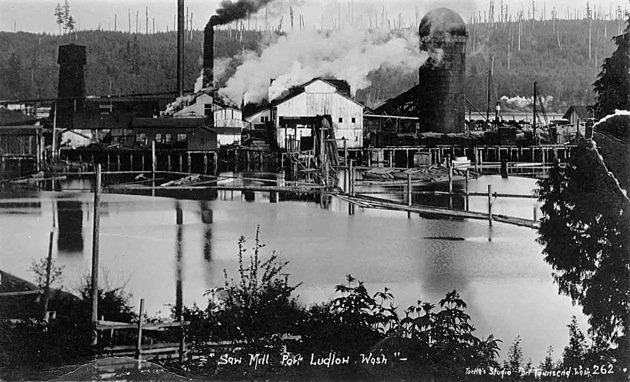
The story of modern Port Ludlow began in 1852 when entrepreneurs Sayward and Thorndyke built the first steam-powered sawmill on Puget Sound here. This wasn't just a mill; it was the genesis of the first mill town in the region, making Port Ludlow briefly the largest settlement in Washington Territory.
Ownership changed hands, with the Port Ludlow Mill Company taking over in 1866 under the management of Arthur Phinney. After his death, the mill's future was secured in November 1878 when it was purchased by the powerful Puget Mill Company for $64,850, beginning its most influential period.

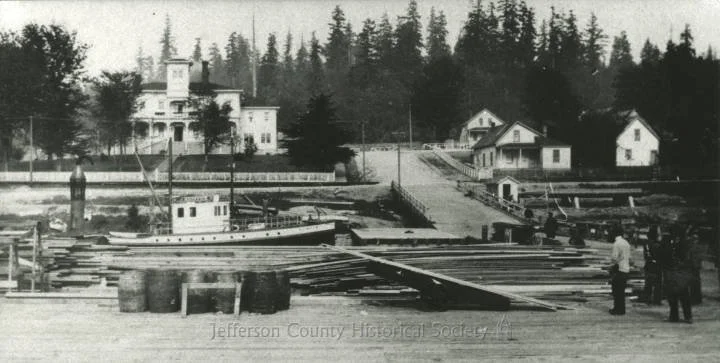
Office of the Puget Mill Co., Port Ludlow (Photo via Barney Burke, www.burkedigitalpix.com)
A Bustling Company Town (1880s)
By 1885, Port Ludlow had blossomed into a full-fledged town of 300-350 residents. Owned almost entirely by the Puget Mill Co., it provided nearly everything for its employees:
Homes: Company-built houses that became hubs for social parties, card games, and Shakespeare clubs.
Amenities: A mill store, post office, telegraph, school, and the Phoenix Hotel.
Connection: Daily mail service by steamer and shopping trips to Victoria for goods and gowns kept the town linked to the wider world.
The industry also thrived. The Hall Brothers shipyard built over 30 vessels here, including schooners for the mill. In 1887, mill superintendent Cyrus Walker built the grand Admiralty Hall mansion, famed for its luxurious imported furnishings.

The Admiralty Hotel’s front doors swung open in a nautical fashion (Photo via Barney Burke, www.burkedigitalpix.com)
Boom, Bust, and the Seeds of Swansonville (1890s)
The mill faced a shutdown during the depression of 1890, but was revived by the Klondike Gold Rush demand in 1897. However, by 1905, the aging mill closed again for modernization.
This pivotal closing at the end of the 19th century created the conditions for our community's next chapter. As the industrial focus shifted, the families who remained began looking inward, building permanent homesteads and dreaming of a different kind of foundation—a spiritual and communal one. Their efforts would lead directly to the construction of the Swansonville Community Church in 1904, marking the transition from a company town to a resident-driven community…

RELATED HISTORY SPOTLIGHTS